Alex Gluchowski on why banks need a control plane for digital assets
Alex Gluchowski, CEO and co-founder of Matter Labs, joins CoinDesk’s Markets Outlook to explain Prividium Commander, software that lets banks and financial institutions issue, run and operate digital asset services under their own rules. He describes operational friction as a large part of the gap between pilots and adoption, and explains how zero-knowledge proofs let data stay within the institution’s security perimeter.
- How identity integration, permissioning, log access and monitoring account for much of the work of moving a digital asset pilot into production.
- Why Prividium Commander works with the private and public chains an institution already operates, with a later path to a ZK-based ledger.
- How zero-knowledge proofs keep data inside the institution’s security perimeter, while the institution decides who sees it and who may transact.
- Why large institutions provision blockchain capacity ahead of peak demand.
Transcript
Alex Gluchowski: It’s clear at this point that all of the markets will be upgrading to digital assets. All of the institutions will be, uh, moving their core systems eventually to, to this new, uh, much more efficient and much more flexible technology. And our mission here is to, to help accelerate this mass adoption, giving the institutions connectivity on their own terms.
Jennifer Sanasie: Alex Gluchowski, welcome to Markets Outlook.
Alex Gluchowski: Thank you for having me.
Jennifer Sanasie: All right, Alex, I’m going to let you kick us off. You just made a big announcement at Money20/20. Talk to us about what it is.
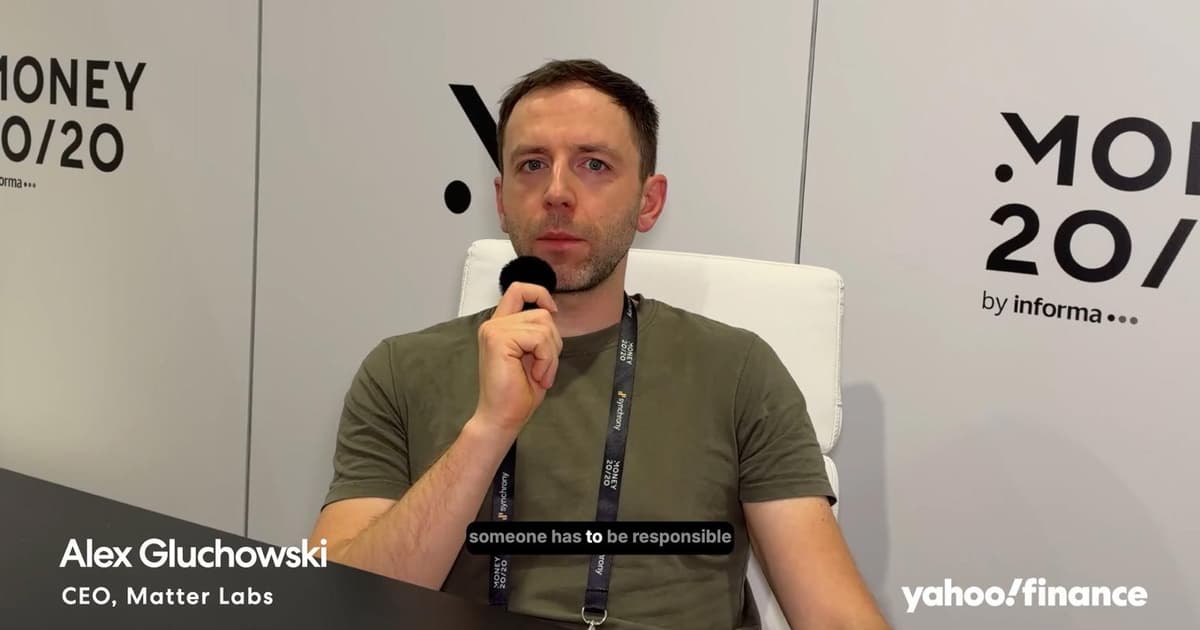
Alex Gluchowski: Uh, well, we announced a new product by, uh, Prividium, which is Prividium Commander. It’s software for banks and financial institutions to issue, run, operate digital asset services under their rules. It’s basically a control plane for your digital assets, for large financial institutions.
Jennifer Sanasie: Talk to me a little bit more about this. Let’s dig one level deeper. What problem does this solve for institutions that they weren’t able to address before?
Alex Gluchowski: We’ve been working with institutions now for over two years. Uh, you know, we’re coming from the crypto native background, building blockchains with zero-knowledge proofs. And as we entered this space, we realized that, uh, the big gap between the pilots and actual adoption of blockchain technologies and digital assets, uh, is to a very large degree, operational friction. It’s very hard for the institutions to operationalize the, uh, you know, pilots, the, the experiments that they have done. Um, because the initial implementation of the digital asset services can be done with this small team. Uh, but as you roll it out to the large organization that is heavily regulated, that has a lot of rules that have to be all followed, a lot of compliance requirements, uh, things become a lot more complex.
So you can think of any kind of SaaS software like a, an AI system or a messaging even, uh, you know, when you experiment with it, you run it for yourself. Maybe you invite two colleagues, you try sending messages, doing some basic operations. It works, but then you have to roll it out to the entire team. You need to integrate your identity systems that are already in place. You need to provide administrative access. You need to provide various degrees of, uh, permissioning. Um, you need to give your security teams and operational teams access to, uh, verify the logs. They’re doing the monitoring, connect the existing systems and, uh, run the data analytics. All of that is orthogonal to the actual operations, to the actual service that you build.
And so many institutions end up doing this plumbing rather than focusing on their core competence, which is understanding the markets, understanding the financial services and products and customers’ needs, and doing the compliance work which they excel at. And so we realized that there is a very big, very big demand for this service. And we moved it into a separate product that institutions can adopt very easily, connect to the existing systems and have a single place from which they manage, control and operate all of the digital asset services.
Jennifer Sanasie: You mentioned that institutions, um, you know, often try to do this plumbing themselves and it takes them away from doing what they’re actually good at. Can you give me an example, you don’t need to name an institution, of, you know, how this has maybe gone wrong, maybe stopped a pilot or derailed a project?
Alex Gluchowski: Well, it’s the numerous institutions that, that you have not heard of. Almost everyone has experimented with digital assets to some degree. Uh, a lot of banks have internal systems, internal ledgers, uh, like Hyperledger Besu, where they are on some internal experiments and some internal operations, but this has not yet entered the mainstream adoption with connection to other banks. Because as you open your system to the external world, the controls become a lot more essential. Whatever could run inside of your organization as a closed loop is not appropriate to just expose to the outside. You really need to manage permissions and policies and do all the compliance controls.
Um, and, uh, I can give you examples of institutions that have implemented this, such as carry network with tokenized deposits, uh, that has thirty banks and launching, marching towards production very soon. Uh, the tokenized deposit core function is relatively small and bounded. Actually, most of the work is in the, uh, in this control and operational layers above it. Tokenization is a relatively simple smart contract, but connecting this to all the systems, giving individual participant banks their own admin, uh, dashboards where they can manage their users, their permissions, their policies, connect to their own core systems. All of that is taking a much larger chunk of the, of the, of the work and the burden.
And these institutions are not really software companies. It’s not their core competency. And it should not be. They adopt products. They adopt various SaaS technologies for treasury management, for sales operations, CRM, and so on. And there is no, no difference, um, or no reason why it should not be the same with digital assets.
Jennifer Sanasie: Now talk to me about the path from this into ZK. Is there one?
Alex Gluchowski: Uh, there is absolutely one. The institutions that adopt Commander can later expand. So Commander works with, uh, existing systems, existing chains that they already operate, both private chains and also public chains. So they can use Commander to manage digital assets on, on the public permissionless chains. And there is a path to upgraded later to a full-fledged, uh, ZK-based ledger that is a high, high performance, secure, uh, blockchain, secure and powered by zero-knowledge proofs. And from there to connect later with other institutions, and we’ll have more to say about this in the near future.
Jennifer Sanasie: When it comes to ZK, talk to me a little bit about what institutions are asking for. I know ZK solves on the privacy front and performance, but what are you hearing from institutions?
Alex Gluchowski: Let’s start with privacy, which is an essential requirement for any regulated entity for, for running their real, uh, internal operations and or like upgrading the internal rails to, to the new digital asset technologies. Uh, privacy, uh, has been a problem that, uh, was attempted to be solved by, by various projects, including a number of projects. And they so far failed to clear this operational ease, this native integration with operational controls, because you either have systems that are, um, fully anonymous, but then the privacy is managed on an individual user basis and there is no overview, there is no access to regulators, to auditors of the bank, to the internal security teams to see what’s happening in there. Or alternatively, there are privacy, so-called privacy solutions that actually delegate a lot of your privacy to, to some external notaries or external third parties that are promising you confidentiality, but you actually have to trust them.
Zero-knowledge proofs, uh, give institutions a direct privacy experience. The data physically never has to leave your devices and systems in your, under your control, within your institutional security perimeter. And you decide on your own terms who you’re going to share the data with, who has access, who may transact and who may not, and so on. Uh, so that’s a fundamental upgrade.
And on the performance side, what we hear is the performance is not so much of a concern today, but the, uh, for at least for the majority of Director of institutions. For some it pretty much is, because they process not thousands, but hundreds of thousands or even millions of transactions per second in aggregate. And so at least for the peak demand times, they need the blockchain systems to be ready. They need to provision those capabilities ahead of the demand, because it’s not acceptable for a large institution to all of a sudden stop because the, you reach the limit and then you start throttling your transactions. And then it leads to some serious consequences, such as cascade of liquidations for trading and other similar issues. And that’s why you need some reserve capability. And blockchain systems so far also have failed to clear the bar. Uh, and luckily we now have very performant, uh, both the core blockchain engines as well as zero-knowledge proofs to secure those engines, uh, with, uh, very high throughput and low cost of operations per transaction.
Jennifer Sanasie: And Alex, the last thing I’m going to ask you is, when you look to the future, you know, what does that future look like that you’re building towards? And how does this new product that you just announced at Money20/20 fit into that?
Alex Gluchowski: Our vision is a global, interconnected digital asset economy, and it’s clear at this point that all of the markets will be upgrading to digital assets. All the institutions will be, uh, moving their core systems eventually to, to this new, uh, much more efficient and much more flexible technology. And our mission here is to, to help accelerate this mass adoption, giving the, the, um, institutions connectivity on their own terms. So what it enables is really having digital assets on your terms, uh, with full control flow flexibility. And this is what we’re building towards.
Jennifer Sanasie: Alex, thanks so much for joining me today.
Alex Gluchowski: Thank you, Jen.