Alex Gluchowski on Prividium Connect and institutional interoperability
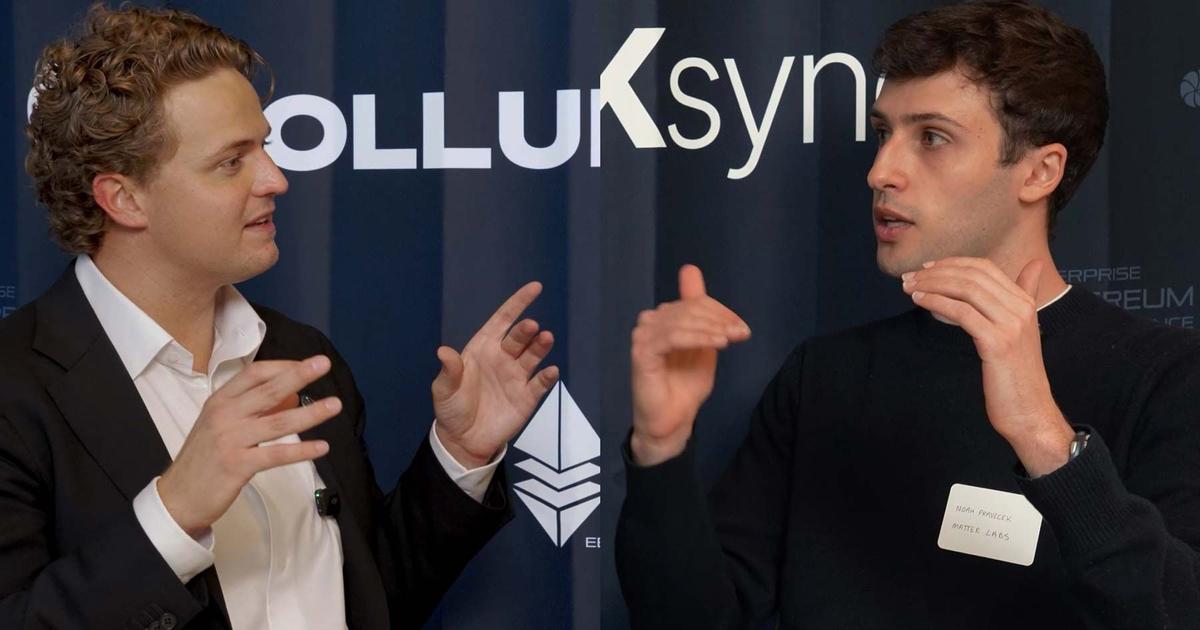
Alex Gluchowski, CEO and co-founder of Matter Labs, joins The Rollup at Digital Asset Summit London on the day Prividium Connect launched. He explains why connecting blockchains is not enough for regulated institutions without privacy and without relying on a trusted third party, how Connect lets counterparties settle on a layer they choose, and how Commander and Ledger let institutions adopt the stack at their own pace.
- Why existing interoperability tools fall short for regulated institutions: they were not built for privacy and rely on a trusted third party.
- How Prividium Connect lets counterparties settle on a layer they choose, such as Ethereum or a shared consortium chain.
- How Commander, Ledger and Connect let an institution start with controls and expand at its own pace.
- Why Alex measures success by production deployments rather than pilots.
Transcript
Robbie: And we are back live from Digital Asset Summit, London. We’re here with Alex G, the CEO of Matter Labs and inventor of ZKsync. And ZK is becoming important again. It feels like the technology is starting to matter again. Alex, welcome to the show.
Alex Gluchowski: It’s a pleasure. Great pleasure to be here as always.
Robbie: Absolutely. I always enjoy these, these in-person ones. Virtual is always fun, but this, this has a different aura to it. And you guys have been announcing, launching new products. Prividium Commander is live, and it’s being adopted by some of the most entrenched and systemically important financial institutions in the world. How does that feel? What has it been like? What is the, you know, where are you on this journey?
Alex Gluchowski: Um, well, we definitely see the, the expansion, uh, going really well with the entire product line. So as you know, we started with, uh, Commander. We previously had Prividium Ledger, our, uh, secure and high-performance ZK-based chain. And just today, we announced the Prividium Connect, a solution for institutions to interoperate without having to rely on a trusted party intermediary or a bridge or a counterparty. And we definitely see the, uh, the interest for Prividium platform as a whole, uh, growing very rapidly. And yes, it’s, it’s great to work with some of the leading institutions in this space, uh, like, uh, DTCC that you mentioned and many others. Uh, very exciting time to be working on the, on this transformative technology.
Robbie: Yeah. I want to get into the vision that you have for the entire product stack, uh, Connect, Ledger, um, as well as Prividium as a whole. And so I’m also curious about your take on the way that private permissioned environments are starting to interface and connect with the public blockchain space. Give us the high level, and then I’d like to get into maybe the different segments of how these products are working, and more specifically, how you’re working with some of these institutions.
Alex Gluchowski: Um, institutions in the digital asset space are moving all at very different paces. So we know that this revolution is happening, but it’s going to be uneven. And some of them are already, uh, running some, some systems like Hyperledger Besu, and some of them are still deciding. Um, there is a kind of a broad range of technologies that are currently in use. Uh, but the common observation we can make is that the systems remain largely fragmented. Yeah, they remain fragmented between private chains run by different institutions and the public chains.
And it’s, um, uh, there’s a reason for this. There are actually several reasons. Um, on the one hand, there is this growing demand, uh, to keep this sovereignty and control over your infrastructure, and coming especially from the regulated financial space. It’s very understandable. You see this also in the AI world, where people are waking up to the fact that you need to keep sovereignty of your, of your digital infrastructure. And it’s obviously even more important in the world of regulated entities, digital assets, uh, where privacy is mandatory by the obligations that you have according to the law.
Now, we have it in the internet world, and you could have connected them with interoperability solutions that are abundant, but this is not happening, right? And the reason is also very interesting. The existing solutions to connect blockchains do just that. They provide connectivity. They were designed for the world of the public chains, and not they, they don’t support privacy. And the existing technologies don’t remove this need to rely on some trusted third party. Okay, so you have to deal with bridges, trusted notaries. Sometimes you shift the, this responsibility to the, to the counterparty. And that is not acceptable from the perspective of really owning your sovereign financial infrastructure stack, right? And this is what we’re solving with, uh, with Prividium Connect.
And so basically the entire Prividium product stack is helping institutions to adopt blockchain technologies at their own pace. If you already have a system that you run, you want to add privacy to it, you embrace Prividium Command, Prividium Commander, you add granular controls, institutional permissions, policies, etc. If you want to go one step beyond and you want to secure your system with the most cutting-edge blockchain stack, you can embrace Prividium Ledger. And if you want to connect to other institutions, irrespective if you use, uh, if you use Ledger or Commander, Connect is there for you now, uh, to, to transact on your terms.
Robbie: I think that’s a very relevant point. So what you’re saying is that it’s not necessarily a network that has to be bootstrapped by other institutions. You can use something like a Prividium Commander or Connect to interface with institutions, whether they’re onchain or not. Maybe you can explain a little bit more about how that works, because for so long it’s like, hey, onchain has visibility and insight into onchain, but it doesn’t have the standardization or the capability of reading offchain or non-tokenized assets, right? We needed an oracle. We needed all these different solutions and different infrastructure components in order to do these things. But what you’re saying now is that we can kind of do this a little bit more piecemeal.
And so, you know, obviously it felt like we kind of started very, very deep, right? We started public blockchain and we reverse engineered, you know, okay, the ledger kind of came first. This was like the deepest part, but it was also the most entrenched. And these institutions come at it from a different perspective. They’re coming at it, we want to do the lowest-hanging fruit. We don’t want to rip out our internal ledger, the place that is very, very core to our business, right off the bat. We want to start by having insight. We want to start by having visibility, and then we want to move deeper into the stack. But obviously it means doing some of the work away from the standardized, you know, tokenization standards and other blockchain standards that we’ve known to accept. So how do you connect two worlds that are operating on different standards?
Alex Gluchowski: So you always start with control. You start with something that, that you understand, and you can fully meet the needs of your customer and your business. And from there you expand, and you see, okay, how, how I can connect, to connect to others. Obviously, there is a huge role that standards play. We can only talk because we use the same language. Similarly, we can only connect if we use the same standard for the tokens, for the transactions that, that we’re doing and so on.
Um, and then there is also a huge role that the public chains play, or private institutional chains, sometimes consortium chains play, because when we transact, zero-knowledge proofs can help us enforce transactional terms. But we also have to make sure that the transaction is irreversible by either parties. And so either you, either you have to trust me, or I have to trust you, or we pick a third place which is credibly neutral, which has very strong guarantees of finality.
Uh, and this is what Connect enables you. The institutions that want to transact will pick a settlement layer. Um, it can be a public chain like Ethereum, and we expect actually a lot of the institutions to gravitate towards public chains with very strong censorship-resistant properties, uh, very strong protection for liveness and neutrality. But in some cases it can be a maybe a consortium infrastructure. You know, if you’re a central bank and you connect to other central banks, it could be a private chain that you operate mutually. The operator of this chain will never see your transactions that you exchange. Prividium Connect protects you, both books of the institutions, and only we will exchange the details necessary for the transaction.
Robbie: Got it.
Alex Gluchowski: So, um, and it will go beyond blockchains. Eventually we will see the final traditional finance is kind of merging into digital asset world. Uh, but for now, we start with blockchains that are easily understood by institutions. And this is a generalized technology stack that is applicable to several use cases across finance as a whole.
Robbie: You guys partnered with the DTC. They’re one of the most systemically important financial institutions in the world. Talk us through their specific implementation, as how, how they’re leveraging the stack.
Alex Gluchowski: Uh, they, they are using Prividium for adding privacy and granular controls.
Robbie: And that’s Commander.
Alex Gluchowski: That’s Commander. And this is what enabled them to move much faster from the, from the initial pilots and ideas towards actually productization of, of their solution for the collateral app chain. Um, uh, you know, Commander solves, um, this, closes this big gap between we can experiment and see that this solution kind of works and goes in the right direction, towards this is usable by our entire organization. We can connect our users, we can connect our policies, we can implement the, the permissioning engine, and everything is configurable and reusable for future installations. So once you launch the first service, adding the next one is, is very easy, because all the systems are in place. So this is what we help them specifically with.
Robbie: We’re, we’re chatting with more of these institutions, you know, day in and day out. It’s funny because, you know, a couple of years ago, it was very much technology-focused, and we were chatting with, you know, the small agile startup in the, you know, onchain-native space that was eons ahead of, you know, the institutions as it pertained to the technology, because that was the focus. Now, the incumbent financial institutions are starting to build some of the same tools. They’re starting to breach into the technology. And so we were chatting with a financial institution just a little while ago who has been, you know, a major player in the repo market and the corporate governance space, and really part of the financial deep state themselves. But now they’re breaking into, you know, tokenization, they’re breaking into the orchestration amongst different tokenized entities. And also something that they, they really emphasized was interoperability.
It feels like these two worlds are converging. It feels like a lot of what you’re describing with Prividium is interoperability amongst financial institutions at disparate places on the tokenization landscape, very similar to the way that the tokenization world was kind of disparate amongst blockchains. Now they’re disparate amongst multiple private, permissioned, uh, environments with different tokenization standards. These things got more fragmented. And so interoperability is becoming even more important and even more of a priority. And it’s being tackled by both the onchain-native, uh, you know, companies such as ZKsync, as well as some of the, uh, more, uh, you know, traditional incumbents and traditional native solutions. And so it just seems like interoperability is becoming kind of the focal point, and it’s being tackled by two different companies and from multiple different perspectives. Just curious if interoperability is the right way to think about the most important priority for the space right now, so that we ultimately bring together these worlds and make a more efficient financial system onchain.
Alex Gluchowski: Uh, this is the problem that actually makes the technology exciting again.
Robbie: Yeah. Technology matters again.
Alex Gluchowski: The world of finance. You know, the, the visionaries of the early Bitcoin era have predicted that we will see this emerging internet of value, where all the systems of the traditional financial world, banks, um, uh, asset managers, will all converge on the standards and will be able to talk to each other, just like this happened to the world of information with the internet. And, uh, people are forgetting that the internet also had a very uneven evolution. It was a bumpy ride. The early version of the internet connected systems together with HTTP and the early web protocols, but they were not very safe to use. You would not put your credit card on the internet, because you had connectivity, but you did not have assurances of authenticity of this communication from your device to, to the end servers of the, of your bank or medical organization or whoever you wanted to connect to.
And we’re living through a similar world. The, the systems can trivially be connected. Connectivity is not enough. You need to guarantee that the rules were followed. And you can do it in many ways. And you can rely on trusted third parties. In fact, we relied on trusted third parties for, for centuries with traditional institutions. They have their place. They will be playing still their roles in many important aspects. But we can take a significant part of this trust away from. We can take the friction out. We can automate parts of this trust. We don’t have to involve trusted third parties for every transaction. We can use systems that are verifiable, that lower the costs, increase the efficiency of the entire financial system, and make the, this connective tissue more seamless.
And this is exactly what zero-knowledge proofs are doing. But you need to apply them in a smart way. You can use zero-knowledge proofs to just verify the signatures, yeah, check the consensus, and like, no, this is not enough. You actually need to check the transactions themselves. And this is what we’re bringing with, with, with Connect. And this is why I’m so excited. And we see this excitement once we explain to institutions what they actually get. They, their, their eyes light up, and we see that, and we expect the, uh, the expansion from here to accelerate.
Robbie: Yeah. And that’s why, again, the technology is starting to matter again. It’s becoming exciting again. And I think ZK is one of the exports of our industry that is particularly exciting and particularly valuable. And, you know, I think smart contracts and ZK, these are the elements that the financial institutions can understand. Crypto is a little too broad. They’re becoming more sophisticated. They’re recognizing the true exports of our industry that they can find very, very valuable and relevant.
And so as we sort of, you know, come to a close on this, on this session, I love just, you know, a little bit of a forward-looking insight from you, because you’re at the heart of this build-out. If we’re sitting here a year from now, you know, it’s the end of 2027, right? It feels like, you know, 2026 is this pivotal moment as we get into the next year, right? This is where the institutions, their eyes are lighting up, to your point. What is the, what is the success criteria, right? If you’re looking back on 2027, what is going to tell you, okay, 2027 was a success for ZKsync?
Alex Gluchowski: It’s definitely growing the, the number of, of players that are embracing technology and going into production. We’re now measuring the success by production. Pilots don’t count anymore. Experiments are not exciting. It’s the players that actually connect their systems and let their customers truly transact and take benefit and take advantage of the efficiencies and new capabilities that the digital asset space is bringing.
But I want to caveat that by saying people tend to overestimate what you can accomplish in one year and underestimate what you can accomplish in five years. So I think in one year, you know, well, we will, you know, the space will look very similar to today, just like much more advanced. But I think in five years it’s going to be completely unrecognizable. Yeah, it’s going to be just, you know, just like you don’t say e-commerce anymore, it’s just all e-commerce, because everything is on the internet. Everything that touches value is going to be on blockchain in one way or another.
Robbie: Yeah, absolutely. Alex, thank you so much. It’s always a pleasure. Love to have you on again soon. You know, one year, five years, we’ll continue to have these conversations. We’re going to see things change in real time. Guys, we’re going to take a quick break, and then we’re going to send it up for our next, our next panelist. Uh, and he’s going to take that one, guys. We’ll be right back.